A Verified Call Checkmark Doesn’t Tell You Who Is Calling
STIR/SHAKEN can show a phone number was probably not spoofed. The FCC itself warns that a checkmark is not proof of who is calling or that the call is lawful.
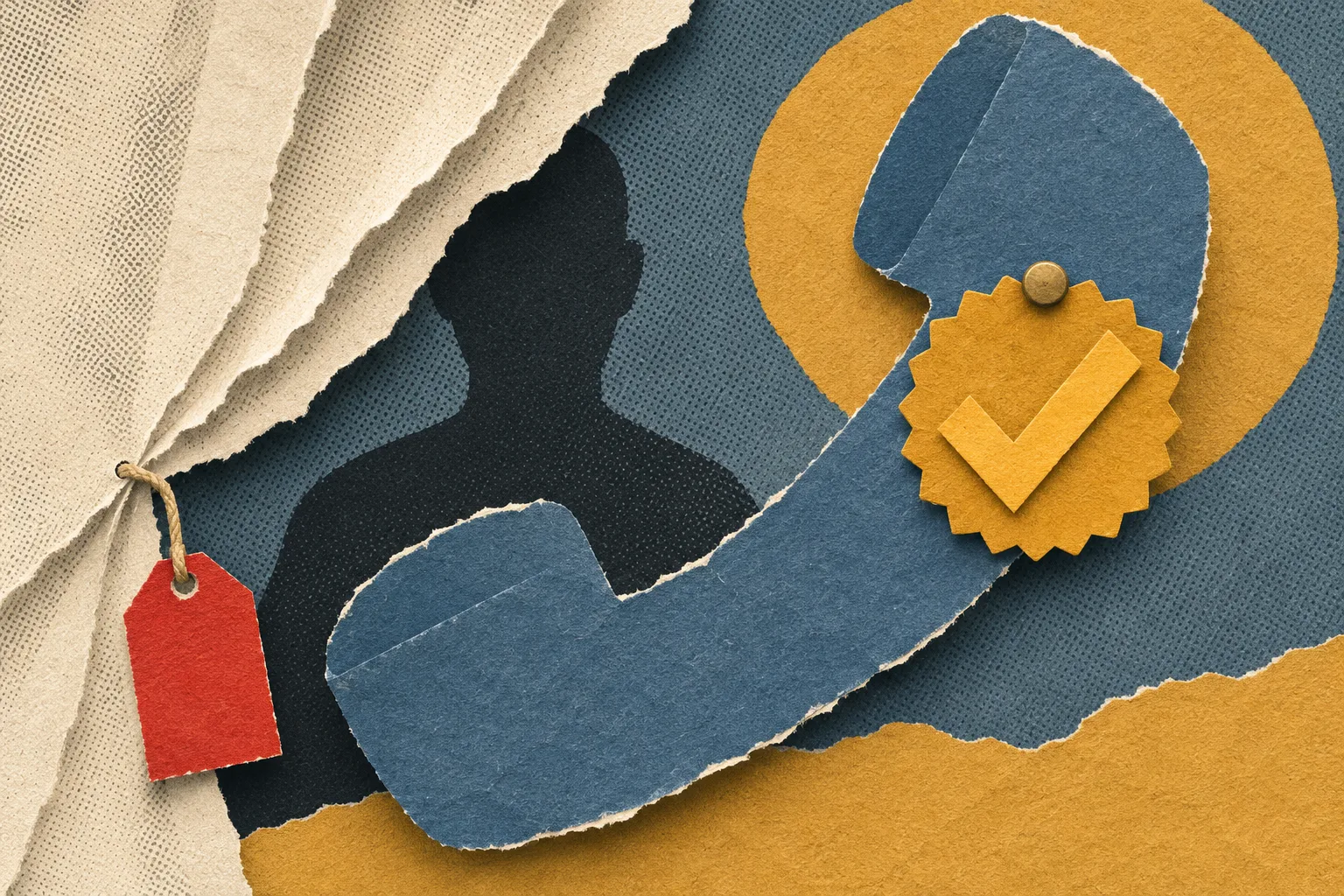
Your phone rings and the screen shows a small checkmark or the words “Verified Caller.” It feels like the network has vouched for the person on the other end. That feeling is exactly the gap the Federal Communications Commission has been describing in its own documents: a call can be technically authenticated and still come from a scammer.
STIR/SHAKEN, the caller-ID authentication framework U.S. carriers use, was built to answer one narrow question: is this calling number likely to be spoofed? It was never designed to tell you who is calling, or why. Understanding that boundary explains why a “verified” scam call is possible.
What the checkmark is built on
Under STIR/SHAKEN, the provider that puts a call onto the network signs it with an attestation level. The FCC’s April 2026 draft rulemaking on enhancing STIR/SHAKEN summarizes the three levels from the industry standard.
| Level | What the originating provider is asserting | What it does not assert |
|---|---|---|
| A (full) | It originated the call, “has a direct authenticated relationship with its customer and can identify the customer,” and has “a verified association between its customer and the telephone number” | That the customer is who their business name says, or that the call is lawful |
| B (partial) | It knows the customer but has not verified the customer’s right to use the number | That the number shown belongs to the caller |
| C (gateway) | It has no relationship with whoever started the call, often because the call entered from another network | Anything about the originator |
The FCC puts the meaning of the top level this way: by asserting A-level attestation, “the provider is claiming that is has knowledge that the number has not been spoofed.” It also notes that B and C calls “are not necessarily spoofed.” So the levels describe how much one company in the chain knows about a number. They are not ratings of the caller’s honesty.
The FCC’s own warning about checkmarks
In a rulemaking notice adopted in October 2025 on call branding, the Commission said STIR/SHAKEN lets consumers know “whether an originating number is spoofed,” but “it often does not let them know who is calling.” It went further: “an A-level attestation indicator alone does not give consumers enough information to decide whether a call is worth answering,” and without accurate caller-name information, “consumers might mistakenly believe that a checkmark or other indication that a call received an A-level attestation is an assurance that a call is not a scam or otherwise unlawful.”
That is a regulator stating the social-engineering risk in plain words. A trust signal that means “number not spoofed” gets read as “caller is legitimate.” The same notice observes that the indicator is inconsistent across phones: “an indicator, such as a green checkmark, might be presented… while the phone is ringing, during the call, solely in the call log after the call, or not at all.” A signal that appears on some calls and some phones teaches people that its presence is meaningful and its absence is suspicious, which is not what it measures.
Evidence that A-level calls carry fraud
The April 2026 draft collects data showing that full attestation is common on illegal traffic. These figures are cited by the FCC from outside sources, and we report them as the FCC presents them.
- In the Lingo Telecom matter, the Commission found that A-level attestations were applied “to 3,978 spoofed robocalls carrying a deepfake generative AI voice message purporting to be from then-President Joe Biden.”
- Citing industry data, the draft says “93.4% of robocall traffic from the most prolific robocall signers now carry A-level attestations” and “48 percent of illegal calls are A-attested.”
- The American Bankers Association analyzed 12,900 calls that illegally spoofed numbers belonging to 47 large banks, retailers and healthcare providers and found that more than half received an A-level or B-level attestation.
Some of these calls had spoofed numbers that should never have earned an A. That points to a second weakness: attestation depends on each originating provider doing its homework. A provider that signs carelessly, or that serves robocallers, can lend its credibility to every call it touches. The draft says the ABA told the FCC that providers “do not verify that the caller has the legal right to use the number displayed” before granting A-level attestation.
Where the chain breaks
Even a well-run system has gaps. An FCC fact sheet from April 2025 says “STIR/SHAKEN only works in IP networks—non-IP technology at any point in the call path creates a gap.” The October 2025 notice adds that “a significant number of calls arrive at terminating providers without authentication information.”
So the absence of a checkmark often means nothing about the caller, and its presence means less than it appears. Caller-name display has its own problem. The notice says legacy caller-name databases are “the only widespread source of caller name information” and “reportedly are not reliably accurate and are subject to manipulation.” A familiar company name on the screen is an entry in a database, not a verified identity.
What regulators are trying to fix
| Measure | Status (as far as we could confirm) | What it addresses |
|---|---|---|
| Third-party authentication rules: providers must make their own attestation decisions and sign with their own certificate | Adopted November 2024 (FCC 24-120) | Stops providers outsourcing the judgment behind an A |
| Call branding: verified caller name, foreign-origin indicator, and limits on showing A-level indicators without verified identity | Proposed October 2025 (FCC 25-76) | The gap between “number not spoofed” and “who is calling” |
| Codifying attestation levels, know-your-upstream-provider duties, blocking unauthenticated calls | Circulated as a draft in April 2026 for the May 20, 2026 meeting; we could not confirm the final text | Careless or abusive signing |
| Non-IP authentication standards | Proposed April 2025; we found no final order | Calls that lose authentication on older networks |
| Removing providers from the Robocall Mitigation Database | Ongoing; 14 providers removed on September 2, 2026 | Cuts off providers with deficient plans |
In the September 2, 2026 announcement, the FCC gave all providers two days to stop carrying traffic from the 14 removed companies. Chairman Brendan Carr said “everyone in this ecosystem has an obligation to step up.” The direction of all these measures is the same: move the system from authenticating numbers toward authenticating callers. Until that happens, the checkmark answers a smaller question than people think.
Why the gap is so useful to scammers
Social engineering often works by borrowing a trust signal from a system that issued it for a different purpose. We have seen the pattern with content credentials, which explain an image’s history but cannot approve its message, and with warnings that people learn to tune out. A verified-call indicator belongs to the same family. It is accurate about something technical, and people stretch it to cover something social.
There is also an asymmetry. A real bank fraud team calling from its own number and a scammer calling from a number they legitimately control can both earn an A. A real bank calling through a vendor on an older network may earn nothing. The signal is not merely incomplete; it can point the wrong way.
What follows for organizations and individuals
For organizations that call customers, the lesson is not to lean on the checkmark in scripts. “You can see we’re verified” teaches customers to trust a signal that scammers can also get. The more durable message is the one we described in why a familiar voice is a clue, not a verification method: invite the customer to hang up and call back on a number they already have.
For individuals, the practical reading is simple. A checkmark suggests the number is probably not faked. It says nothing about whether the caller works where they claim, and nothing about whether you should act on what they ask. If a call asks for money, codes or remote access, the checkmark should change nothing about what you do next.
Finally, the law draws the line where social engineering lives. The Truth in Caller ID Act, as the FCC’s notice quotes it, makes spoofing unlawful when it is done to “defraud, cause harm, or wrongfully obtain anything of value.” Spoofing is the tool. Deception is the offense. Authentication can make the tool harder to use, but the deception still has to be caught by people and processes.
Sources
- Call Branding, Further Notice of Proposed Rulemaking, FCC 25-76 (FCC, adopted October 28, 2025): limits of A-level attestation, indicator inconsistency, caller-name databases, Truth in Caller ID Act wording.
- Enhancing STIR/SHAKEN, fact sheet and draft (FCC, April 29, 2026): attestation definitions, abuse data, proposed measures.
- Non-IP caller ID authentication, fact sheet (FCC, April 7, 2025): IP-only limitation.
- Eighth Report and Order, FCC 24-120 (FCC, November 2024): third-party authentication rules.
- FCC removes 14 providers from the Robocall Mitigation Database (FCC, September 2, 2026): removals and Chairman Carr quote.
Found a factual error or a source that has changed?
Send a correction →