Content Credentials Can Explain an Image’s History. They Cannot Approve Its Message.
Separate media provenance, factual accuracy, identity, and authority. A valid content history is useful evidence, but it does not verify a payment request or claim.

A video arrives with a badge suggesting that its history can be checked. That sounds reassuring in a world of synthetic images and cloned voices. But what exactly has become more trustworthy: the file, the claim made in it, the identity of the sender, or the action the viewer is being asked to take?
Those are separate questions. Content provenance can contribute evidence about a media asset’s origin and editing history. It does not automatically establish that a statement is true, that a speaker represents an organization, or that a payment instruction is authorized. The distinction matters because a genuine-looking badge can become another cue that carries more authority than it should.
What the technology is intended to add
The C2PA explainer describes Content Credentials as signed provenance information associated with a media asset. It explicitly distinguishes provenance from whether content is true, accurate, or factual. Validation concerns the represented record and its relationship to the asset; it is not a universal truth detector.
The Content Authenticity Initiative describes tools for recording and displaying provenance, including content made with generative AI. Identity information can be optional. The details available to a viewer depend on the asset, implementation, and supported viewing tools. Do not infer a complete biography of a creator from the mere presence of a credential.
This article is not an implementation guide or an assessment of every current C2PA product. It examines the reasoning a reader or organization should apply when provenance information appears alongside a persuasive request.
One file can support several different stories
Consider an illustrative photograph of a flooded street. The file may have a verifiable creation and editing history, while the caption incorrectly says it shows a different town or a different date. The provenance could help an investigator examine the mismatch, but the credential itself does not automatically correct the caption.
Now imagine the photograph appears in a message asking for emergency donations. Even if the event is accurately described, the payment destination still needs verification. A real emergency, a real image, and a fraudulent collection request can exist in the same message. Establishing one true element does not validate the entire transaction.
This is the same reasoning problem discussed in our analysis of familiar voices. A cue may be meaningful without being sufficient. The action should be authorized through an appropriate route, not inferred solely from the persuasive quality of the surrounding media.
A question-by-question reading guide
| Question | Potentially useful evidence | Still needs separate checking |
|---|---|---|
| How was this asset produced? | Available provenance and editing assertions | Whether the record covers the part you care about |
| Does the caption describe the event correctly? | Original publication and independent reporting | Place, date, context, and omitted information |
| Who is contacting me? | Established account and contact verification | Whether that channel is controlled by the expected person |
| Can they request this action? | Business or personal authorization process | Amount, recipient, scope, and purpose |
The table deliberately includes evidence outside the media file. A file-centric tool cannot answer every relationship or workflow question. For high-impact actions, the most important evidence may be a known contact route or an existing approval record rather than another image-analysis result.
A badge in a screenshot is only a picture of a badge
If someone sends a screenshot showing a verification result, you are viewing their representation of the result. You have not necessarily checked the original asset with the relevant tool. The screenshot may be incomplete, outdated, associated with a different file, or simply not enough to establish what was validated.
When provenance matters, inspect the original available asset through a reputable, appropriate tool and understand what the displayed result says. Do not install an unfamiliar verifier at the sender’s instruction or upload confidential media to a public service merely to satisfy curiosity. The verification method itself has privacy and trust requirements.
A workplace should define which tools can receive internal material. A sensitive recording can expose people, business information, or private conversations even if the user only intended to check whether it was synthetic. Verification should not create a new data disclosure.
Missing credentials do not settle the opposite conclusion
If a viewer cannot find provenance information, that absence alone does not prove that the content is fake. There are many media workflows, and the available record may be incomplete or not displayed by the tool in use. Keep the result at its actual scope: you could not establish a supported provenance record through that method.
The same caution applies to an AI-detector score. A score is not a complete account of the event, the speaker, or the request. If you use such a tool, understand its limitations and avoid treating a confident-looking output as a substitute for independent evidence.
Our piece on what a screenshot-based AI check cannot establish addresses this broader evidence problem. A narrow input can produce a fluent answer while leaving the decisive context unseen. A careful workflow records that uncertainty instead of hiding it behind a label.
Why the action can matter more than the media
Suppose a clip appears to show a company leader asking an employee to send a confidential file. Even if the clip were entirely authentic, the employee would still need to know whether the recipient, purpose, and sharing method are approved. The video might be old, out of context, or unrelated to the specific request accompanying it.
A well-designed process does not require the employee to become a forensic media examiner. It gives them a known way to confirm a sensitive instruction. The answer may come from the appropriate manager, data owner, or established approval system rather than from a judgment about facial movements or audio quality.
This is not a claim that provenance is useless. Better evidence about media history can help journalists, investigators, and readers. It is a claim about scope: useful evidence for one question should not silently become permission for another.
How a publisher can describe its own media honestly
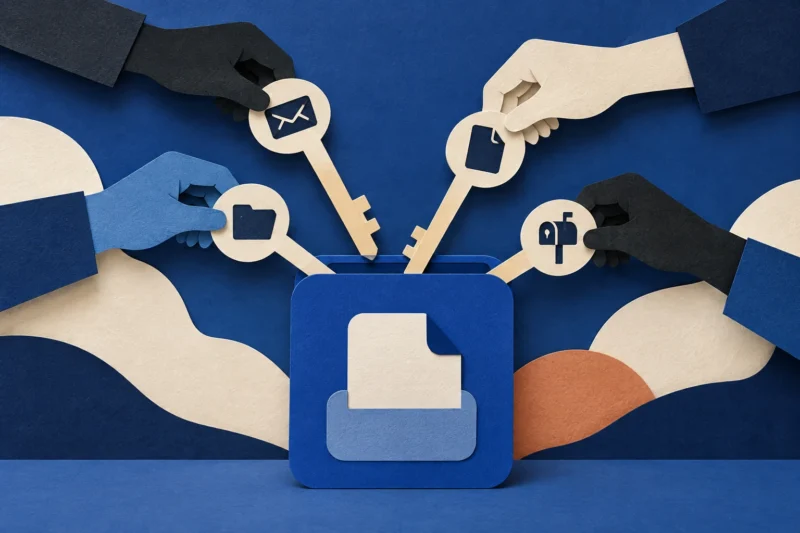
A publisher should distinguish documentary evidence from illustration. A generated editorial image may convey a concept effectively, but it should not be presented as a photograph of a reported incident. A collage of an inbox, a phone, or a payment route is an illustration unless the publication has evidence supporting a more specific claim.
Captions and surrounding text should make the role of the asset clear. Do not imply that an image proves a statistic or reconstructs a real person’s experience unless that claim is supported. The cover illustration on an analysis article can help readers understand the topic without pretending to be source material.
If a publisher uses provenance tooling, it should explain what the record covers and what it does not. Avoid a blanket “verified true” badge. That phrase conflates production history with editorial fact-checking and can give the audience an inaccurate impression of what has been examined.
A newsroom-style verification note
For a consequential piece of media, keep a short internal note: where the asset was obtained, what original source was located, which provenance information was available, what contextual facts were independently checked, and which questions remain unresolved. Keep the note factual rather than converting uncertainty into a confidence percentage without a defensible method.
Separate the asset from the claim. A note might say that the available record supports a particular creation history, while the date asserted in a viral caption remains unconfirmed. That is more informative than a single real-or-fake verdict. It also makes later corrections easier because the reasoning is visible.
Do not expose private contributors or sensitive location information unnecessarily when publishing a verification account. Provenance and transparency can have privacy consequences. Decide which details the audience needs and which should remain restricted to the editorial or investigative process.
What to do with a persuasive message today
If you share the result with someone else, include its limits. Passing along “the image was checked” without saying what was checked can create another layer of borrowed confidence. A short explanation of the source, method, and unresolved question is more useful than a verdict that sounds broader than the evidence.
First identify the requested action. If it is merely to read a story, evaluate the reporting and context. If it asks for money, credentials, account access, or confidential information, pause that action and verify through an established independent route. Do not let a media badge decide the transaction for you.
Next, describe the evidence precisely. “This tool displayed a provenance record” is different from “the person is genuine” or “the request is approved.” Ask what additional fact would actually resolve the decision. In many cases, that fact concerns authority, not the pixels.
Content Credentials can make parts of media history more inspectable. The safest use of that improvement is to keep it within its boundaries. A trustworthy file history is one piece of evidence in a larger conversation; it is not a signature on every claim or instruction that someone attaches to the file.
Found a factual error or a source that has changed?
Send a correction →