The Government-Call Scam Has Changed. The Verification Rule Hasn’t.
Impersonators now mix official-sounding calls, video, payment demands and isolation. An FBI alert points to the scale of the problem—and to a simple way to break the script.
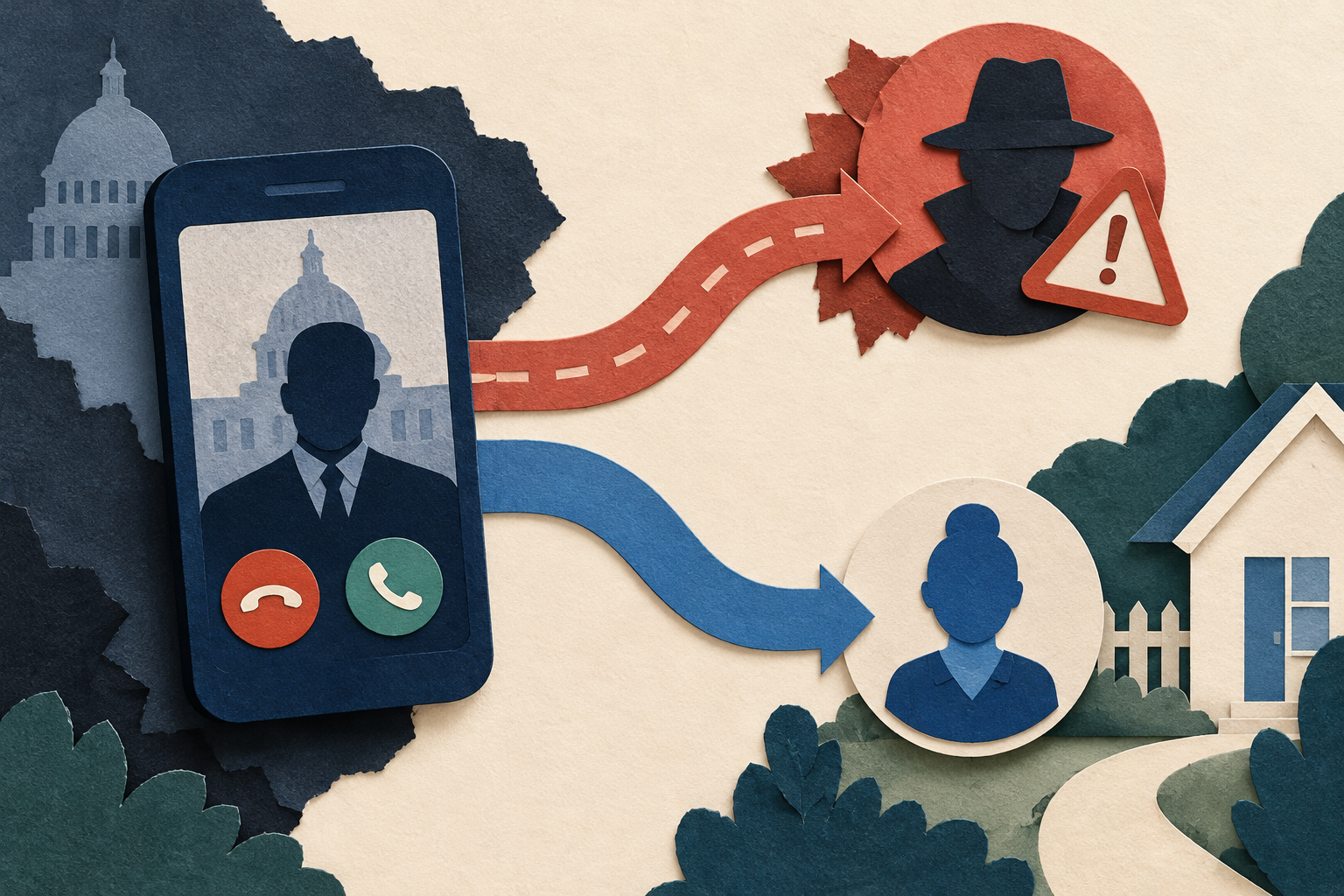
A call arrives with an official title, a serious tone and a detail that sounds plausible. Perhaps there is a problem with a tax record, a warrant, a benefit payment or an account. The caller may insist that a camera stay on, that a bank employee cannot be trusted, or that the next step must happen before the end of the call. The pressure is not an accidental flourish. It is the mechanism that keeps the target from checking the story with somebody else.
On September 17, 2026, the FBI’s Internet Crime Complaint Center warned about scammers impersonating law-enforcement and government officials. The bureau said it had received nearly 61,000 related complaints from January 2025 through July 2026, with reported losses above $1.6 billion. The warning describes an evolving mix of phone calls, text messages and video calls, as well as demands involving wire transfers, cryptocurrency, cash kiosks, couriers or prepaid cards. Those figures cover complaints reported to IC3; they are not a count of every attempt or a measure of every person affected.
Why an official voice can short-circuit good judgment
Social engineering works by borrowing a relationship or a role. Government impersonation borrows both authority and consequence. A target is invited to believe not only that the caller is legitimate, but that failing to comply will make them look guilty, irresponsible or unsafe. Shame and urgency narrow attention. Once someone is focused on avoiding an imagined penalty, an unusual payment method can feel like a temporary administrative step rather than a warning.
Video can intensify that effect. Seeing a face, badge-like graphic or formal background may feel like proof, but a video call still begins with a channel chosen by the caller. A polished image does not authenticate the person, the agency or the claim. The same is true of caller ID, a copied letterhead, a case number supplied by the caller, or a website reached through a link in their message.
The important question is not “Does this look official?” It is “Can I verify the claim through a channel I chose independently?”
What the pattern looks like—and what it does not prove
There is no single script. An impersonator may claim that a target’s identity was used in a crime, that a payment is overdue, or that a family member is in danger. Another may pose as a local officer and suggest that a person can quietly resolve a problem by moving money. Some calls arrive after a real-looking text or email; others begin on social media. The common thread is the attempt to keep the target inside one controlled conversation.
One detail deserves particular attention: a request to move funds in order to “protect” them. A demand to use cryptocurrency, gift or prepaid cards, a cash machine, a courier, or a wire transfer is not made safer by a caller’s title. The FBI says real law-enforcement and government agencies do not demand payment in those ways to settle an alleged case. Do not test the caller by arguing about policy; end the contact and verify separately.
| Pressure in the contact | A safe interruption | Independent check |
|---|---|---|
| “Stay on the line; do not tell anyone.” | End the call. A legitimate process can survive a second opinion. | Use a number or website you already know, or find through an official government directory. |
| “Move your money so we can protect it.” | Do not transfer, withdraw or hand over funds. | Contact your bank using the number on your card or statement, not one provided by the caller. |
| “This video proves who I am.” | Treat video as presentation, not authentication. | Call the agency’s publicly listed switchboard and ask whether the matter exists. |
| “Use this link or case number now.” | Do not open the link or rely on the supplied number. | Type the agency’s known address yourself and navigate from there. |
A five-minute verification routine
- Stop the clock. Say you will call back through the agency’s published number. You do not owe an unsolicited caller a continuous conversation.
- Separate devices if possible. A second phone or a trusted person’s device makes it easier to research without using a link supplied in the message.
- Find the contact route yourself. Use an official directory, a statement, a government portal you have used before, or a known public switchboard. Do not rely on a search advertisement or a URL sent in the contact.
- Describe the claim, not your private data. Ask the agency to confirm whether it has a matter for you. Do not volunteer a Social Security number, bank login, one-time code, or identity document merely to “clear your name.”
- Bring in a second person. A relative, colleague, attorney or bank representative can help notice contradictions while the stress response is high.
If the supposed agency cannot be reached immediately, that is not a reason to pay the caller while you wait. Preserve the message, caller number, payment instructions and transaction records. Do not forward a suspicious link to family members as a warning; describe it without making the link clickable. If there is a credible immediate threat, contact local emergency services using the number appropriate to your location.
If money or information has already been shared
Move quickly, but do not let a second caller turn the first loss into another one. Contact the bank, card issuer, payment service or exchange through its official channel and ask whether the transaction can be stopped or the account secured. Change passwords from a trusted device if credentials were exposed, revoke unfamiliar sessions, and secure the email account that can reset other accounts. If a one-time code was shared, tell the provider that an authentication code may have been used to take over the account.
Report the incident to the relevant national fraud-reporting service and local law enforcement where appropriate. In the United States, the FBI directs victims to IC3 at ic3.gov; the official site does not charge a fee to file a complaint. Keep copies of everything, including the time, account names and transfer details. A report does not guarantee recovery, and anyone promising guaranteed recovery for an upfront fee should be treated with suspicion.
For a broader look at why a real authentication prompt can still be wrapped in a false story, see our guide to unexpected MFA prompts and the context around them.
Make the pause ordinary
Families and workplaces can make verification feel less like an accusation and more like routine. Agree in advance that anyone can pause a call, ask a second person, and call back through a known number. Create a simple phrase for genuine family emergencies, but do not treat a phrase as the only safeguard; an attacker may have personal details. For employees, managers should reward early reporting even when the message turns out to be harmless.
The most useful response to an official-sounding threat is not perfect detection. Scams are designed to arrive at inconvenient moments and use details that feel personal. A reliable process does not require a person to identify every fake on sight. It gives them permission to stop, leave the channel and check the claim somewhere the caller does not control.
Sources
- FBI IC3, “Scammers Impersonating Law Enforcement and Government Officials in Fraud Schemes,” September 17, 2026.
- FBI Internet Crime Complaint Center (IC3): official reporting site.
Found a factual error or a source that has changed?
Send a correction →

