The Countdown Timer That Never Ends: What Retail Urgency Teaches
Researchers found fake countdown timers on shopping sites, and the FTC calls them a dark pattern. What holiday deal pressure may teach people about deadlines.
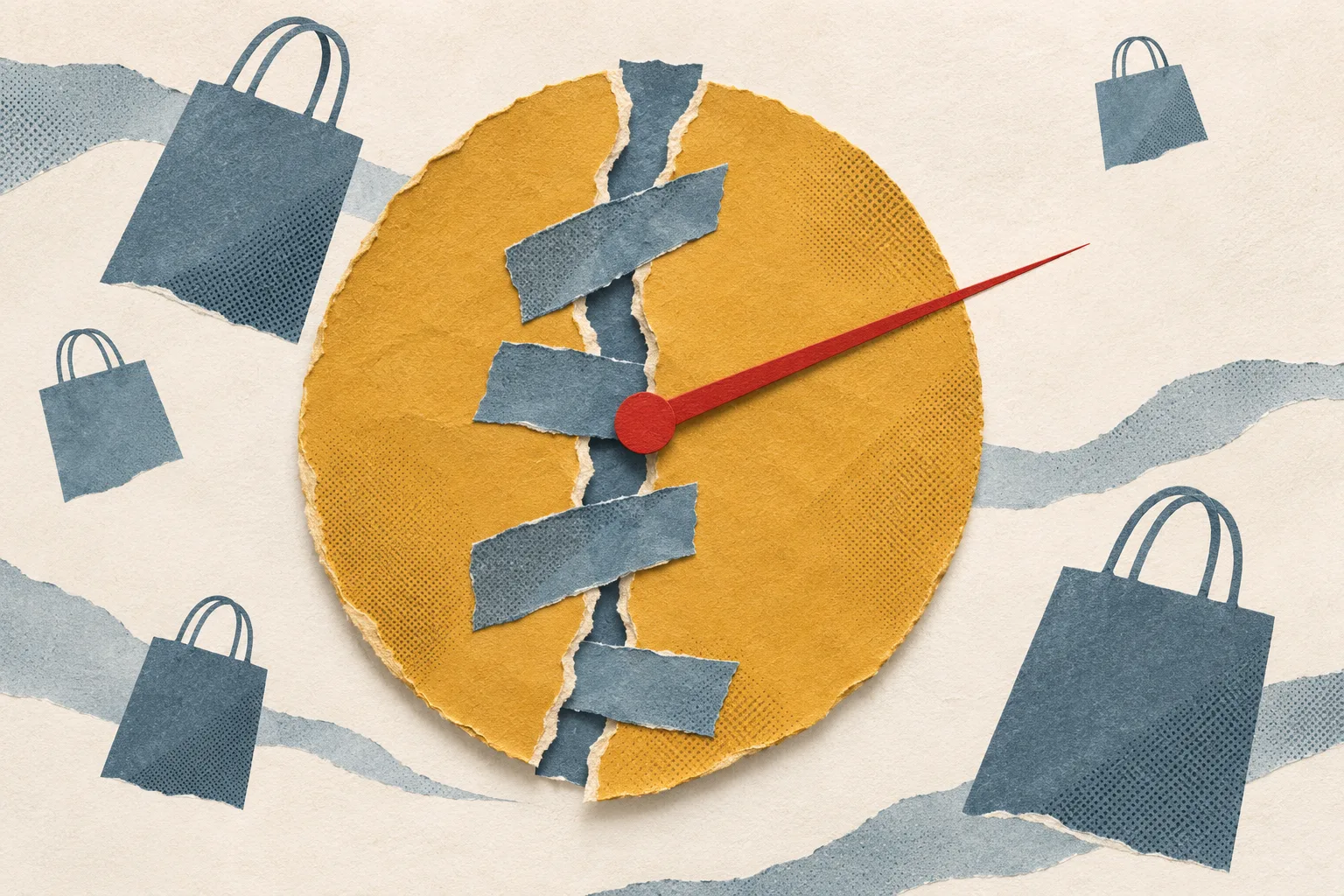
It is the week before Black Friday, and a banner tells you that a sale ends in 00:59:48. You close the tab. An hour later, you open it again and the same offer is there, with a new clock. Most people have shrugged at this sort of thing. It is a small dishonesty, and the stakes are a pair of boots. The question worth asking is what those thousands of small deadlines do to how a person responds to the next one, particularly when the next one comes from someone who wants more than the price of boots.
A large academic crawl found deceptive countdown timers on 140 shopping sites, and the FTC lists baseless timers among dark patterns. We found no study showing that retail timers make people more vulnerable to scams. The shared mechanism, and what the commercial examples show about designing a deadline, are still worth understanding.
What researchers actually measured
In 2019, a research team led from Princeton published “Dark Patterns at Scale,” an analysis of 53,000 product pages from around 11,000 shopping websites. They found 1,818 instances of dark patterns across 1,254 sites, about 11.1% of those crawled. They then examined countdown timers for deception, visiting sites repeatedly and watching what happened when the clock ran out.
The figure is a floor, for reasons the method itself reveals. The crawler looked at product pages and checkout paths on a defined list of sites in one period. It could only label a timer deceptive if the behavior was observable. And the data is from before 2020, so we cannot say what the proportion is now. It is reasonable to say that fake deadlines were documented as a real and repeated practice, and not much more than that.
The authors also noted a related form they called the limited-time message: static copy saying a sale will end “soon” without stating when. By not naming a deadline, the message can’t be proven false. It makes the same kind of claim while taking on less risk.
What the FTC says
The FTC’s September 2022 staff report, Bringing Dark Patterns to Light, lists a “Baseless Countdown Timer” among its examples: “Creating pressure to buy immediately by showing a fake countdown clock that just goes away or resets when it times out.” The report describes panelists at its workshop discussing “countdown timers on offers that are not actually time-limited” along with claims that an item is almost sold out when supply is ample. Quoting a UK regulator’s paper, it adds that false or misleading scarcity claims “can put undue pressure on consumers to act.”
Note what kind of finding this is. The FTC classifies the practice, and treats fake claims as deceptive. The report does not measure how many sales the timers produce or estimate the harm for a typical shopper.
The shared mechanism, and where the comparison stops
A retail timer and a scam script use the same underlying move. Each imposes a deadline the other side controls. Each makes checking feel expensive, because checking means possibly missing out. We have described what urgency does in a fraud in our analysis of how it removes the second opinion.
| Feature | Fake retail timer | Scam deadline |
|---|---|---|
| Who sets the deadline | The seller | The criminal |
| What it wants to prevent | Comparison shopping and second thoughts | A call to anyone who could stop it |
| Claimed cost of waiting | Losing a discount | Arrest, a frozen account, a relative in danger |
| Actual cost of waiting | Usually none, in the cases the study identified | None; the threat is invented |
| Size of the harm | Typically small | Can be life-changing |
| Legal status | A possible deceptive practice | A crime |
Those last two rows stop the comparison from going too far. A retailer running a fake timer is not a scammer in any useful sense. The value of the comparison lies in the middle rows.
Could the habit transfer? What we can and can’t say
It would be convenient to claim that fake timers make people easier to scam. We found no study that tests this, and we are not going to assert it. Two opposite effects are at least plausible.
The first is conditioning. Someone who encounters deadlines all day may come to treat “act now” as an ordinary feature of being a consumer, and to act on it with less reflection. The other is inoculation. Someone who has watched timers reset may learn that deadlines are usually fake and develop a healthy skepticism. It is possible that both happen, to different people, depending on their experience. Anyone making a confident claim in either direction has gone beyond the evidence.
What does seem defensible is narrower. Commercial design has normalized a form of pressure, and it means that a pressure tactic does not, by its presence, stand out as unusual. A person cannot use “this message is rushing me” as a reliable alarm in an environment where nearly every message is rushing them. A similar argument appears in our piece on real companies teaching bad security habits.
What it would take to find out
The question is testable, even if no one seems to have tested it. A study could expose people to shopping interfaces with and without fake deadlines, then measure how they respond to an unrelated request with a time limit. Over a longer period, researchers could compare people who report recognizing reset timers with those who do not, and ask how each group treats a pressured phone call. Until something like that exists, this is a reasonable hypothesis, and it should be presented as one in a talk or a training deck.
Why holiday volume changes the picture
Seasonal shopping adds three conditions that aren’t present most of the year.
- Real deadlines are common. Shipping cutoffs and one-day sales really exist in late November and December. A fake deadline hides among real ones.
- People expect messages. A delivery notice or a payment problem seems normal when several orders are in transit.
- Attention is rationed. Decisions are being made quickly, on phones, between other tasks. Our piece on decision overload describes the workplace version.
Teams running customer support or fraud operations already plan for that volume, which we covered in peak season as a capacity problem. The consumer side of it receives less design attention than it deserves.
A test for a real deadline
For someone facing any deadline, commercial or otherwise, a few questions can separate the ones that merit attention from the ones that don’t. They work because they do not depend on how the message feels.
| Question | Points toward a real deadline | Points toward a manufactured one |
|---|---|---|
| Can I confirm it somewhere else? | The date appears on the retailer’s own policy page or an official notice | It exists only in this message or banner |
| What happens if I miss it? | A concrete, modest result: full price, later shipping | Vague or catastrophic |
| Does the offer come back? | Sales recur, and you have seen it end | The clock restarts on a refresh or in a new tab |
| Is someone asking me not to tell anyone? | No | Yes, and that alone is reason to stop |
| Is it asking for an unusual payment or a code? | No | Yes |
A note for product and marketing teams
People who build commerce sites are in a position to contribute here, and the case does not depend on proving a link to fraud. If a timer does not correspond to a real end time, the FTC staff’s view is clear enough that this is a problem on its own. A straightforward rule follows: a deadline shown to a customer should be true, and the system should be able to demonstrate it. It should end when it says it ends, and an expired offer should stay expired. That rule costs some short-term conversions, and in exchange it means your deadlines keep their meaning for the customers who rely on them.
It also serves a modest public good. Each true deadline helps preserve the idea that a deadline carries information. For a person facing a very different kind of clock, that idea may be the thing that makes them stop and ask who set it.
Sources
- Mathur et al., Dark Patterns at Scale: Findings from a Crawl of 11K Shopping Websites (Proceedings of the ACM on Human-Computer Interaction, 2019): data set, instances, deceptive timer test and count, limited-time messages.
- Bringing Dark Patterns to Light (FTC staff report, September 2022): baseless countdown timer example, workshop discussion, scarcity quotation. FTC press release (September 15, 2022).
Found a factual error or a source that has changed?
Send a correction →