“Show me your utility bill”: the door-to-door energy switch disguised as a service check
A recent doorstep pitch described as a utility “energy savings task” led to a supplier-switch contract. Learn how to verify the visitor, protect your utility account details, and check state-specific cancellation options.
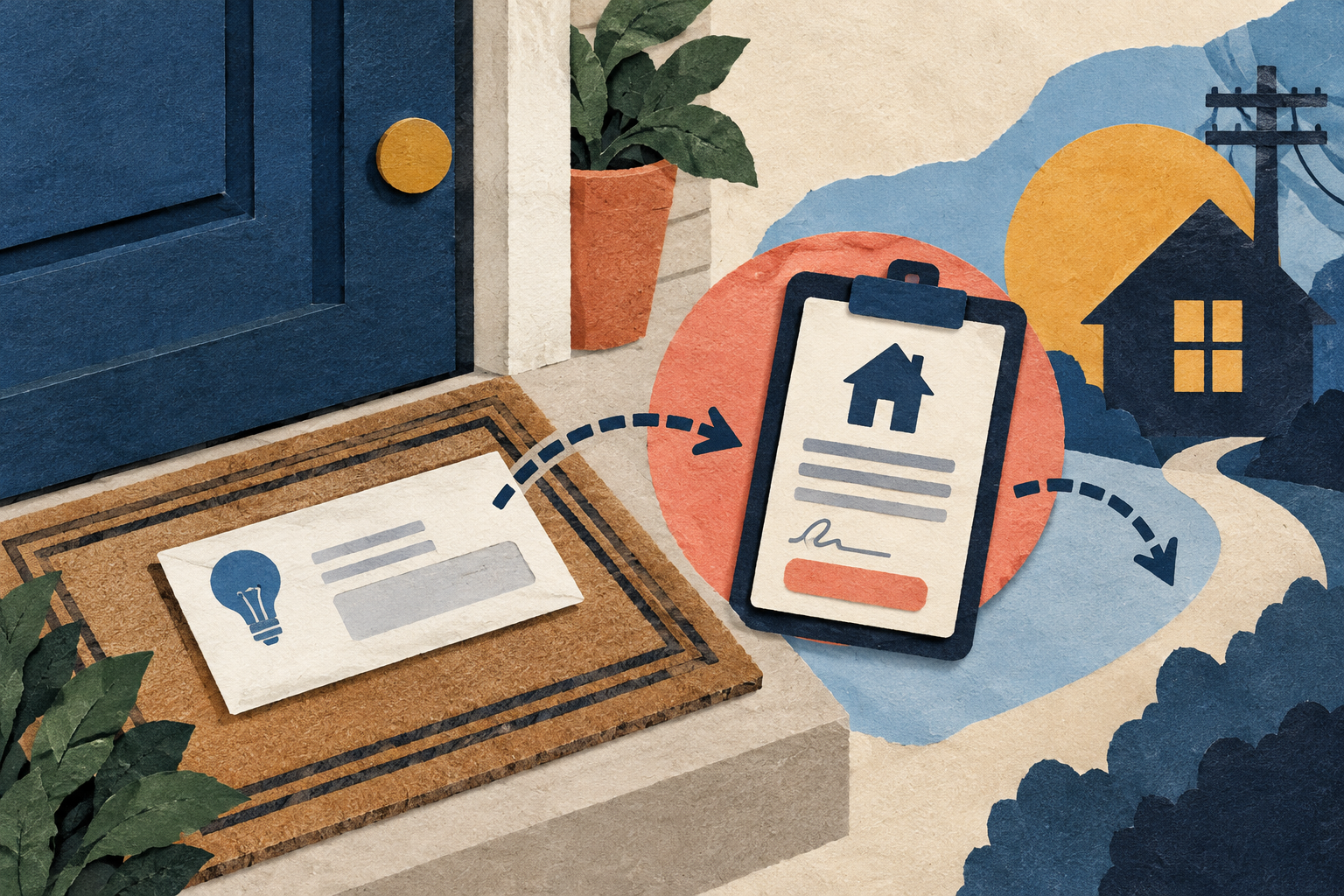
A recent New Jersey Reddit post describes a visitor who framed a sales link as a required “energy savings task” connected to the local utility. The link, the homeowner said, was actually an electricity-supplier contract. It is one person’s account—not proof of a company-wide practice—but it highlights a confusing interaction that consumers and regulators have discussed for years.
The opening can sound administrative rather than commercial: “We’re checking your energy savings,” “We need to update the account,” or “You haven’t completed the utility task.” A representative may wear a badge, mention the name of the familiar utility, and ask to see a bill. The homeowner may assume the visit concerns service, rates, or a required account check. But the actual purpose may be to sell a contract with a third-party energy supplier—or, in a worse case, to obtain account details for an unauthorized switch.
Those are not identical situations. In some U.S. states, customers can legally choose an alternative electricity or gas supplier. Door-to-door sales may be lawful if the salesperson accurately identifies the company and follows local rules. A legitimate offer is not automatically a scam. The consumer risk is that an optional sales pitch can be framed as a required utility procedure, while a rushed signature or account number can be used to start a contract the resident did not knowingly choose.
The Reddit thread that prompted this guide, posted in New Jersey in March 2026, says a visitor first claimed to be with PSE&G, then described herself as a contractor, asked for contact details, and sent a link that the poster said led to a supplier-switch contract. The poster also reported giving an account number before recognizing the link. These claims are not independently verified, and the thread does not establish what the company, utility, or regulator found. It is best read as a case study in how ambiguity at the door can turn into a consequential decision.
Why the bill is the leverage point
A utility bill can contain more than a balance and a service address. Depending on the state and provider, it may include account identifiers or customer-choice information that a supplier uses during enrollment. A visitor who asks to “check a rate” might only need enough information to quote a price—or might be seeking data that makes it easier to submit a switch request. The Maryland Office of People’s Counsel advises customers not to show a supplier’s sales agent a utility bill or provide the utility account or Customer Choice ID number. That is Maryland-specific consumer guidance, not a universal rule for every market, but it illustrates why a bill should not be treated as harmless paperwork.
There is also an asymmetry in the interaction: the visitor can scan or type a few details quickly, while the resident has not had time to compare the offer, read the contract, or confirm whether the person works for the utility. Once a text arrives on the resident’s own phone, the message can feel more trustworthy simply because it is on a familiar device. But a link sent during a doorstep conversation is still a sales channel chosen by the visitor.
Separate the three possibilities
| What the visitor may be doing | What makes it easy to misread | Your boundary |
|---|---|---|
| Utility maintenance or a real service visit | Workers and contractors may need access for scheduled work, but an unsolicited visit still needs independent confirmation. | Keep the door closed; call the utility using the number on your bill or its official app to confirm the work order. |
| Lawful third-party supplier sales | The salesperson may discuss a legitimate competitive supply option but blur the distinction between the utility and the supplier. | Ask for the seller’s legal company name and say you will compare the written terms later. No bill or account number at the door. |
| Misleading enrollment or impersonation | A claim that the switch is required, that the utility “sent” the visitor, or that service or savings depend on signing now creates pressure. | Do not sign, scan, read out a code, or approve a texted link. Verify through the utility and state regulator independently. |
A badge, branded shirt, or a name-drop does not settle which category applies. Nor does the existence of an official-looking webpage. Verification should answer a narrow question: who is this person selling for, and is this visit a utility service appointment or an optional supplier offer?
Questions that cut through the script
- “What company do you work for—not the utility you are comparing yourself with?” Ask for the supplier’s legal name and a written offer.
- “Is this an optional contract to change my energy supplier?” A plain answer should distinguish a sale from a required service or account update.
- “What is the price per kilowatt-hour or therm, and for how long?” Ask whether the price is fixed or variable, when it can change, and what fees apply.
- “Is there a monthly charge, cancellation fee, introductory period, or automatic renewal?” A low headline rate can be offset by additional charges or a later variable rate.
- “Where can I verify your license and compare offers with my state regulator?” Use a regulator’s site that you navigate to yourself, not a QR code or web address on the visitor’s phone.
- “Can I take the documents and decide later?” If the answer is no, end the conversation.
What a meaningful comparison requires
In a retail-choice market, the utility may continue to deliver power and maintain the wires while a separate supplier provides the energy commodity. The customer may still see one bill, which can make a supplier change look like a routine utility update. The details and availability of choice vary by state and utility territory. The U.S. Department of Energy describes retail electric choice as a state-dependent market structure; it is not a nationwide system where every household can freely switch suppliers.
Before comparing an offer, put the terms beside your current supply rate and calculate the likely total—not just the teaser rate. Check:
- Rate structure: fixed, variable, or introductory; and when a rate can change.
- Term and renewal: contract length, end date, rollover terms, and how notice is delivered.
- Fees: monthly charges, cancellation fees, enrollment charges, and taxes or pass-through items.
- Eligibility and claims: whether advertised savings, renewable content, or rebates are guaranteed and how they are defined in writing.
- Cancellation: the correct procedure and deadline under your state’s rules.
Do not assume that the utility’s delivery charge will disappear if you change suppliers. In many choice programs it remains, because the local utility still delivers energy and handles infrastructure. The supplier’s quoted rate may cover only one component. Compare the full bill and use an official regulator or consumer-counsel comparison tool when available.
What regulators say—and why the state matters
Consumer protections are local. Ohio’s Office of the Consumers’ Counsel explains that many Ohioans can choose certified suppliers and that door-to-door enrollments have specific disclosure and independent-verification safeguards. Maryland’s Office of People’s Counsel warns customers not to hand a sales agent their bill or account identifiers. Delaware’s Public Service Commission says a third-party supplier does not represent the state commission or utility. These are examples, not rules that automatically apply where you live.
Look up your state public utility commission, public service commission, or consumer counsel using a government domain. Check whether the seller is registered or licensed, whether the market permits residential choice in your area, and what cancellation rights apply. Avoid relying on a salesperson’s explanation of the law or on a search result that resembles a regulator’s name.
If you already showed the bill or tapped the link
You only showed the bill: contact your utility through the number on the paper bill or official app. Explain that an unverified visitor saw the account information and ask whether a supplier change is pending and whether an account-level block, PIN, or alert is available in your area. Protections differ by company and state.
You entered information in a form: save the text, email, screenshots, and any contract copy. Do not send additional codes or identity documents in response to follow-up messages. Call the utility independently and ask whether a switch request has been submitted. Contact your state regulator or consumer counsel if you did not knowingly authorize a change.
You signed an agreement: find the supplier’s name, contract terms, enrollment date, rate, cancellation method, and deadline. Contact the supplier and utility using independently verified channels and ask what options are available to cancel or reverse the switch. Some jurisdictions provide a rescission or cooling-off period for certain sales, but the time limit and process vary; do not assume the same number of days applies everywhere. If the contract was misrepresented, preserve evidence and file a complaint with the state regulator and consumer-protection office.
You gave a one-time code or account password: contact the affected provider immediately through its official channel. A utility supplier switch should not require your email password or a security code for an unrelated account. Change a disclosed password and review account access if you shared one.
Household rules reduce pressure without assuming bad intent
Agree that nobody changes a utility contract during an unexpected visit. Residents can accept a leaflet or company name without providing a bill, a phone number, an account ID, or an electronic signature. If one person is comfortable comparing offers, they can do it later when the full contract is available. For older relatives, renters, roommates, or anyone who manages bills with another household member, put the policy in writing and identify who is authorized to make changes.
For property managers and community organizations, a short notice at reception can help: “Utility contractors may be scheduled. Verify appointments with management. Energy-supplier sales are optional; staff do not collect account numbers at the door.” Do not post personal account details or resident names where visitors can read them.
Bottom line
A person at the door may be a legitimate salesperson, a genuine contractor, or someone misrepresenting their role. You do not have to decide which in the moment. Treat “show me your bill” as a request for sensitive account information, not as routine proof of identity. Get the seller’s actual company name, take the terms away, and verify the visit or offer through channels you choose. A real choice should still be there tomorrow after you have had time to read the contract.
For another workplace and building-access example, read how visitor processes can reduce pressure at a controlled entrance.
Sources
- r/newjersey, March 2026: homeowner’s report about a doorstep supplier-switch pitch (anecdotal and unverified)
- Maryland Office of People’s Counsel: third-party suppliers and protecting utility account information
- Ohio Office of the Consumers’ Counsel: Energy Choice—Know Your Rights (Ohio-specific rules)
- Delaware Public Service Commission: Customer Electric Choice (Delaware-specific market information)
- FTC: scammers pretend to be your utility company
- FTC: avoiding solar and clean-energy scams
Found a factual error or a source that has changed?
Send a correction →

